Pin The Tail Revisited

Since there was a definite outcry of support for more birds after the last post, I’ve decided to appease the teaming millions and feature a bird for this post.  This particular set of pictures is actually a bit of a surprise.  If you recall, I introduced the Northern Pintail back in June of last year (link here).    In that post I mentioned there was a better set of pictures likely to come from the second day of shooting.

I managed to process this second set of images yet they didn’t find their way onto the blog.  Nothing like spending time on something only to find there were no fruits of the labor.  As you can tell, the missing images were found (while processing the Katydids from the last post).  I do like these shots better – the previous ones were mostly from behind and didn’t give a good view of the overall bird.  The right side view:

the left side view:

and the front!  That pretty much covers all the angles with the tail side covered in the previous post.

Hit the jump to read some more about the Pintails

Continue reading Pin The Tail Revisited

Katy Did Creep Me Out

It’s a new month and that means a minimum of another 6 posts.  Based on my productivity in the darkroom as of late coupled with the need to really get through a backlog of topics, this month may end up having a few extra posts – a bonus if you will.  I already have the images worked up for another 7 posts and have another 8 or so in the queue that just need some finishing work on the images and upload to the Smugmug galleries.  probably put emphasis on the photography aspects more than the textual part but we’ll see how it goes.  Once I start typing I tend to get immersed and next thing you know it’s a small novel.  Also have a variety of topics ..yes, including birds.. so it should be a fun month.

Figured I’d start with a theme that hasn’t been covered in awhile – those creatures that roam the night and are drawn the warm glow of our porch light.  That’s right, another dose of a night out with the Macro.

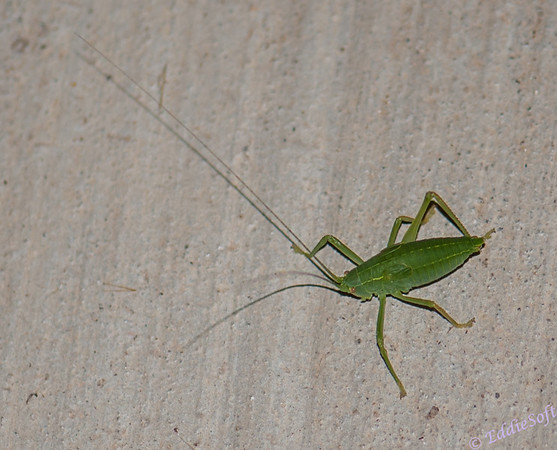
This particular set of shots was taken at two distinct times during the Spring/Summer months.  I forgot to write down the exact dates but I am making an assumption that this first set was taken in the Spring because I think this particular creature is a Tettigoniida or more commonly referred to as a Katydid or Bush Cricket.  In our region they are referred to as Katydids.

The reason I think this was taken in the Spring is this is when the Katydid’s hatch into nymphs.  These nymphs look identical to their adult form with the exception of not having their wings.  We’ll get to those images a little later in the post.  At first I was searching the grasshopper reference books assuming it was one of those.  Through luck (as in using the Google search criteria of “large green bug”) the possibility of the Katydid came up.  Again, the part that was throwing me was the lack of leaf like wings.  The long antennae, the lanky legs and the profile of the body seemed to fit.  Upon careful examination, it did appear that there were tiny little wings starting to emerge on the side.  You can just make them out if you look straight up from the middle leg.

Hit the jump to read more about the Katydid

Continue reading Katy Did Creep Me Out

A Cute Mute Pt 2

It is dog show weekend and that can only mean one thing.. that’s right, plenty of time to type out a post which, by the way, completes my monthly quota.  February is always a tough month due to being ripped out of two full days.   But enough whining, I know you want to get onto the post.  Today we bring out the big guns.  The first set of the Mute Swan series (link here) brought you the pictures of Swan cygnets which are umber cute in my book.  Unfortunately, there was room for improvement on the execution of those shots for a number of reasons including distance and light topped off by I just failing to hit my marks.  Figured the cuteness factor would help compensate for the softness and the hard light in the later shots.  Truth is I put those in the first set because I had a much better offering and wanted to build on the excitement.  Going right for the jelly always dampens the experience of that tasty Mel-O-Cream Bismark doughnut.  Yum, but I digress.  Leading with my favorite and soon to be uploaded Gallery shot on the newly redesigned EddieSoft Photography site (link here):

The reduced size takes a little away from the eye.  Normally shots from the back do not work that well, but the fact he (also referred to as a Cob) was looking back at me with that smirky don’t even try to sneak up on me look provided a nice composition.  As with all the Mute Swan shots in this series, these were taken at Banner Marsh in Banner IL.  Thanks to our friends over at Wikipedia learned that this pose is known as busking and as suspected in this particular setting a display of threat.  No fear dude, just hanging out here on the banks of the marsh snapping a few shots… now my wife over there .. yeah, the one over there with that long stick trying to smack the Canada Goose she sees.. well she is dangerous – just ask the Geese that crossed her path on the golf course – the horror, the horror (just kidding, Linda was behaving herself .. or was she?)

Hit the jump to read the rest the Mute Swan series post

Continue reading A Cute Mute Pt 2

Book Recollection: Deadly Instinct

I bet you thought the next post would be Part 2 of the Mute Swan post.  I felt bad having to go back to the bird topic so quick after the barrage from Project Chekov so trying to ease you back onto the feathered features.  Instead figured it was about time to throw out another Book Recollection.  Today’s recollection comes to us thanks to Melissa Farris who compiled a product she called Deadly Instinct.  I can’t remember what made me aware of this book, but my guess would be one of the wildlife photographers I follow on Google+ brought it too my attention.  No need for a lot of convincing past the cover which had the National Geographic seal along with a Lion bringing down a Wildebeest – I’m in.   Big thanks to Linda who ended up getting me this book for Christmas.  Technically, coming in at only 180 pages, it is really more of a photography book than a reading book.  There was a setup at the beginning of each chapter that set the tone for the set of images.  Once that page or two was consumed, it was on to a nice collection of shots… umm let me correct that.  There were some FANTASTIC shots, a lot of cool wildlife shots and then some I simply put in the TOTAL CRAP category.  I’m sorry, but I like my pictures to be in focus and the attempt to show speed by throwing the shutter speed way low resulting in a blur you wouldn’t even know what it was unless they told you is not worth my time – trust me, there were more of these shots than I would have expected alongside the other quality shots.  I wouldn’t let the bad shots deter you from enjoying all the good shots, but note to author – there were plenty of better shots you could have used of the Gorillas. The best part of the book was it had a number of pictures from my favorite photographer – Joel Sartore.  If you recall I featured one of his books previously called Rare (link here).  I had a feeling some of his work would be included based on the National Geographic stamp on the cover.  Pretty used to his style these days and can usually pick out his work without seeing the credits first.  Was surprised to learn he started on his naturalist journey after seeing the harsh conditions of the Galveston coast.  Always cool to learn more about the background of photographer’s you spend a lot of time following.

I should probably mention something before people run off to purchase this book to see the “purdy” pictures.  The pictures are not all “pretty” in the hang on your wall and let your visitors gawk over mode.  The truth is the intent of the book is to show how lethal, dangerous and aggressive wild animal behavior is.  If you are weak of stomach or god forbid a PETA member save your money and go watch the Muppets Movie instead.  This book is full of violent, bloody wildlife on wildlife encounters.  Oh, and a lot snakes so Linda has been warned to never open the book herself – about 5 pages in there is a particular awesome picture of a Vine Snake that even made me hesitate when I turned to that page.  Also very appreciative of the heavy paper stock she used which helps maintain the quality of the pictures.  Kudos to the photographers that provided all the outstanding shots to this book.  It always inspires me when I see the work of photographers that are clearly on top of their field.  A pretty short recollection but the book only took me two nights of light reading before hitting the hay.

Hit the jump to see my takeaways.

Continue reading Book Recollection: Deadly Instinct

A Cute Mute Pt 1

I tried really hard, but I just can’t go that long without a bird post.  At least I gave you a little bit of a break, but as sure as the sun will rise tomorrow, we are once again featuring a feathered friend  .. wait, let me put a little more emphasis on that .. featuring a NEW bird to the blog.

To be honest, I kind of held back on this one during Project Checkov.  I had plenty of ‘S’s for that particular post, but I did wimp out and use the Mallard for the ‘M’ entry when in fact I had this water bird available.  Wait a minute, I might not have mentioned the whole basis for Project Chekov.  I think I at least hinted that there was a theme in a previous post but maybe didn’t state it for those that didn’t figure it out.  Each entry of that post started with a different letter in alphabetical order.  That element made the effort extremely difficult requiring a number of days to lay out that series with the photographs that were in the backlog.  If you didn’t catch that you may have underestimated just how hard that project was.  Oh and of course the name was a play on the fact I was trying to complete a bunch of CHECK OFFs on my bird list.  There isn’t a real check mark until a picture is taken and it shows up on this blog.  There was one and only one reason I didn’t go with this bird over the Mallard and that is due to the end of this title – there were too many shots I wanted to feature and why this post is really spread out over two parts.  Rather than get ahead of myself, let’s focus on the aspects of this set of Mute Swans!

All of these pictures were taken down at Banner Marsh in Banner Illinois over different visits to the marsh.  Every time we head down there, we are greeted by at least one Mute Swan hanging out among the weeds or enjoying a slow paddle on the water.  I never really thought much of it while taking the shots, but this particular Swan has a pretty narrow distribution in North America predominantly around the Great Lakes region.  They are  primarily a European and Asian Swan but introduced into North America in the late 19th century.  Some consider the Mute Swan an invasive bird due to their disruption to the natural waterfowl population.

Hit the jump to see a few more shots of these rather large birds.

Continue reading A Cute Mute Pt 1

Project Chekov: Zenaida Macroura

With a slight tear in my eye I must declare we’ve made it to the end of Project Chekov.  It’s been an incredible ride but time to make the final post and declare victory.  It isn’t often that I’m able to close out a new resolution so early in the year, but as mentioned at the beginning of this project there was a sense of urgency.  This little project literally allowed me to jump about a year ahead in the posting queue which I would never had been able to do at the standard pace.  Admittedly there were a few jumps even further than that due to some unforeseen circumstances but worth it to keep my commitment to the project (I generally hate failing at something unless I’ve given it all I had).  There will probably be a summary post to put a bow on the project, so for now let’s get to the star of the post.

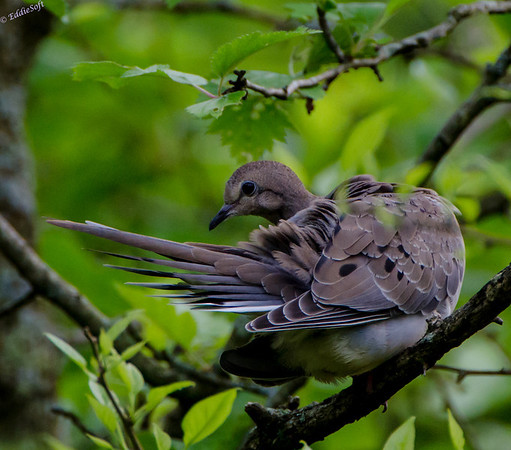
For those in the States, this should be a pretty common bird – the Zenaida Macroura.  You would think that such a common bird would have a more common name .. well it does.  Their non-scientific name is Mourning Dove and to my utter surprise, they are also called Turtle Doves!  That brings a completely new understanding of the 12 Days of Christmas song… okay, maybe not but now at least know what they are referring to.  By the way, from a composition and execution perspective, the shot above is one of my favorites.  Similar to the one below, but the foreground branch is a little more invasive there.  If you are curious, this one was “rainbathing” – Wikipedia claims they can keep this outstretched wing position for up to twenty minutes.

According to our friends over at Wikipedia, these birds are monogamous and form strong pair bonds.  In alignment with that, these birds are usually seen around the feeder in pairs and are often found sitting in a tree next to what I assume is their mate.  They are prolific breeders having up to 6 broods a year with an average of 2 eggs per brood.

Hit the jump to read more interesting facts and view a few more shots of the Mourning Dove!

Continue reading Project Chekov: Zenaida Macroura

Project Chekov: Yellow-Rumped Warbler and Yellow Finch

If you would been around LifeIntrigued headquarters today you would have seen one very panicked owner tearing his hair out.  Things were going so well and we could see the end in sight for Project Chekov.  Just a couple more posts and the featured birds were already worked up in the digital dark room and ready to go.   Just a little bit more work and pop that bottle of Moscato…. and then the wheels fell off.  I went to research some details on the Yellow Finch which was the targeted featured bird of the day.  A few clicks later and a dash for the reference books informed me that there really IS NOT a Yellow Finch.  They are really named American Goldfinches.  Since I’ve been a little kid I’ve always referred to them as Yellow Finches – WTF.  Hell, they certainly are not Golden – they are YELLOW.  Panic, sweating, shaking .. was this all for not!?!

Then it hit me, there may be a way out, but it was going to take some digging to find TWO shots out of the entire collection of Yellowstone National Park shots taken last May.  There was a chance encounter with a bird – a fleeting moment I was able to capture in the tin.  An hour or so later I was staring at this:

Every photographer has a few shots that he or she will look back on with a huge grin on their face.  This is one of those for me.  We were with our friends (Dr. Giselle and David) on a trail coming back from photographing a waterfall.  All of a sudden an intriguing bird flew in our direction and landed on a nearby branch.  Instincts took over, the Beast was pressed into action, settings manipulated in a flash of an eye and the shutter was pressed.  I had time to press the shutter one more time and that bird was gone baby gone.  If you haven’t worked with big glass before you probably do not understand what a miracle it was to get a single crisp shot under those conditions much less two.  Based on the coloring, I was pretty sure what it was at the time but made a mental note to get back and verify it as soon as possible – that mental Post-It-Note must have flown off on the way back to the car because I forgot about it until today.  The yellow word was a double reminder for “Yellowstone” and the “Yellow” bird that we found there.

A little bit of digging in the reference book brought a huge sigh of relief from me – sure enough it was Yellow-Rumped Warbler.  Now that was close – a 5 second encounter on a trail out in the Wilderness had saved nearly a month long project.  For the curious, this appears to be the Audubon variety based on the strong yellow marking on the neck and missing the white eyebrow.  It was located in their Summer/Migration spot so guessing it had just arrived being that it was May when we were there and still pretty cold in the area.  All I can say to that bird is thank you thank you thank you for a brief but project saving encounter.  Oh, and of course another check mark in the birding list (technically there was a poor shot while covering a previous Yellowstone shot but we’ll consider these better shots as the official sighting).

Hit the jump to read about the originally planned featured bird

Continue reading Project Chekov: Yellow-Rumped Warbler and Yellow Finch

Project Chekov: Xanthocephalus

This guy totally lucked out on Project Chekov.  When planning this project I was a little worried about two postings – specifically the 21st and the 24 (which happens to be this one).  There was nothing in the tin for a Sabine’s Gull or a Terek Sandpiper.  By the looks of their regions it doesn’t look like we’ll be getting either of those anytime soon.  But there was one option still left … one long shot that might just save me, but that would require me to go digging through the pictures taken during a side trip out to Yellowstone last May.  Ladies and gentlemen, we have success!

On our way out West, Linda found a birding preserve not too far off the path.  I’ll go into where that was when I finally get around to posting about that trip, but there was a number of memorable finds there that stuck out.  This particular bird was one of those – without further delay, please welcome Xanthocephalus Xanthocephalus to the blog.  One second while I add a new check mark to the birding list….

Cornell’s website states they are Migratory across Illinois, but I have never seen one here (for that matter anywhere until then) so not buying that – for the record, Wikipedia does not indicate it hangs out in Illinois either.  I would not forget a bird sporting this distinct of a color palette.  To save some typing let’s just call it by its non-scientific name, the Yellow-Headed Blackbird (Mr. Obvious bird namer strikes again).  It was pretty easy to tell from the behavior that this was a close relative of the Red-Winged Blackbird based on it’s aggressive behavior and nonstop squawking.  It just replaced the red wing highlights with a bright yellow hood – well, at least the males.  The females and juvis all sport the boring brown.

I went ahead and added this next picture to the set even though it was slightly soft.  It showed the white markings which is generally only visible when it is flying – it was windy that day and was doing its best to stay balanced on the cattail.

Big thanks to Linda for finding that location.  We were the ONLY ones there and had the entire acreage to ourselves – well, ourselves and a ton of birds both on land and water.  I could have spent the entire day there but eventually we had to get back on the road again – that and the mosquito repellant was running low.  Look for more shots to come from that shoot, but for now we’ll call this another successful entry in Project Chekov.

Project Chekov: Wren and Woodpecker

Greetings everyone, we are back on the highly underestimated Project Chekov.  Definitely having fun doing it, but it is a struggle to stay on top of.  Speaking of that, this little bird on top of a birdhouse has caused a little bit of a headache.

Back in June 2011 (told you I was behind) Linda and I went to one of our favorite local birding sites in Jubilee College State Park.  They have a pond there that tends to attract a wide variety of birds and dragonflies and animals and hell spawn MOSQUITOES – all good things come at a price I guess.  While we were there, this little bird decided to come out and pose for the cameras.  Want to know beside Sparrows what other birds I have difficulties with?  … you guessed it, this bird!

They are small and brown with some gray – yeah, normally I would call it a Sparrow and move along but these are smaller, have a more tapered/thinner tail and probably more distinguishable thin down turned bill.  This is the point where I throw up the Wren sign instead.

Hit the jump to see a few more shots of this Wren and the other featured bird for this post!

Continue reading Project Chekov: Wren and Woodpecker

Project Chekov: Vulture

Okay, we are kinda back on track with Project Chekov.  The last post took us a little out of our targeted  region.  The good news is we are back in North America.  On the disappointing front, I must have been drinking heavy in the digital darkroom one day based on the set of images that were planned for this post.  In the pre-upload check it became apparent that every single one of them was beyond acceptable crispiness – translated, very soft and fuzzy.  The entire set went into the trashcan!  Every once in awhile a benefit pops up from having such a large backlog of shoots – there’s plenty of other bird images to choose from.  Knowing we had taken a number  of shots of this bird while out in Texas, I popped back into the digital darkroom and worked up a few replacement images.

If you are from the Midwest at least, you might recognize these gruesome birds.  That is if you happen to spot them when they are not cruising circles high in the sky.  This hard to look at without grimacing bird is the Turkey Vulture.  The bird is not new to the blog having been featured in a Wisconsin post (link here) and an Indiana post (link here).  The posts from Wisconsin show the more common shots of them in the sky.  The odd thing is they look pretty normal from below and their wing markings from underneath look pretty cool with the white nicely contrasting with the darker wing fronts.  Now when they get on the ground it is a completely different story.  The one above is trying to dry the grease and gunk on the wings collected from playing in whatever dead carcass they happened to find that day.  Think this was mentioned in the previous post, but they even piss on their own legs to help kill the bacteria … yeah, imagine what it feels like to look at these creatures in the big glass.

If you can get past the wings, you still have the face to deal with.

From afar the detail is lost, but up close you can see they have a face only their mother could love.  It is not surprising they have very few predators eesh.  Here is something I didn’t know about the Turkey Vulture.  According to our friends over at Wikipedia – they do not have the common bird vocal organ (syrinx), meaning they can only make hisses and grunts.    It did indeed get its name from the face similarities to the Wild Turkey although it is sometimes referred to as a Buzzard (hmmmm is that due to all the flies that buzz around their food source – just may have to look that up).  Wanna guess how it defends itself..?.. if you said it regurgitates on their enemies you win a prize

Take special note of that beak – their feet are poorly adapted for ripping and tearing the flesh and organs out of carrion – they literally stick their heads into the rotting carcass and rip and tear it apart with that fierce looking bill.  Okay, this is making my stomach queasy so better end this post.  Don’t get me wrong, these birds serve a valuable purpose in the circle of life, but some things are better left in the dark!

Have a good one and catch you again real soon.