Book Recollection: Creative Bird Photography

I am pretty ashamed of myself right now.  Remember that goal of getting through my ever growing stack of reading material?  If not, I completely understand since I haven’t posted a book recollection since ..wait for it .. wait for it.. APRIL (link here).  Pretty pathetic, but there are some reasons for that and most of them result in just being too tired or busy to sink myself into anything with any intellectual depth.  As a result most of my night and travel reading has been running and health magazines that invade my mailbox once a month.  There are usually some interesting quick reads in the running journals but I am quickly coming to the conclusion that my health mags are worthless – give them three months and they will contradict every recommendation they gave you in the current month.  I’ll be ending those and my Guitar World subscription at the next renewal.

The bright spot in all of this is I have been turning a few pages in a real book every once in awhile.  Somewhat shocking I actually came to the index on one last week.  Which means it’s time for a new Book Recollection – WOOT!!  Today’s entry is about an offering from Bill Coster on Creative Bird Photography: Essential Tips and Techniques.  Pretty sure Linda picked it up for me – obviously she knows me pretty well.  This is a 160 large paper bound book printed on nice stock pages which make the numerous pictures stand out nice and crisp.  To be honest, it was more of an inspiration book than a volume of new information.  This isn’t Bill’s fault but I have read so many books and manuals on wildlife photography that it takes something revolutionary to really grab me.  However, if you like perusing some of the best bird photographs you will ever see.. then this book is for you!  This is where the inspiration comes from – nothing like seeing successful shots out in the field to get your juices flowing to go out there and try to get your own gallery shots.  When it comes to bird photography, Arthur Morris is clearly in the cream (can check out his work out here) Beware, that dude is a Shopaholic in case you have some angst on that (I DO NOT).  Based on the images in this book I am going to add Bill into this elite group as well – strange that I have never stumbled on his work before.  He also gets extra props because he started in the IT Industry before going full time into photography – his sweet spot back then were birds in flight which were pretty rare in the film days.  This led to his employment with one of the top natural history agencies in Britain.  Oh, did I mention he was raised in London?  This particular book was based on a series of articles he wrote for Birds Illustrated magazine – maybe I’ll replace my health subscription with a bird journal .. maybe even on the iPad.  He does an excellent job of giving the details (bird type, location and exposure information) for all the shots in the book.  Note he is a Canon user – let’s all let out a collective siiigggghhhh.

One thing that becomes very clear in the book is Bill has a lot of spare time and is very patient in the field.  He details all of the locations around the world he’s been able to shoot at (many of which I’ve added to my travel list) and continually mentions the multi-day outings just waiting for a bird to show up where he wants it to.  This is a huge advantage over holding down a full time job in the IT world.  I actually have a pretty big list of takeaways so clearly it was worth the read if you can call 160 pages in 5 months actually READING.  There are 38 unique birds (class and common name combined) within the covers (yes, I counted them) and I’m sure some of them you have never seen in person.  If you are new to bird photography or wondering why anyone would take up this pastime, then this book is for you.  If you want to judge how far you need to go before you can call yourself a real bird photographer, then this book is for you (answer a LONG ways for me) or if you just like looking at “purdy” pictures then … this book is for you.  If there is one negative on the book is that it just simply ends.  One moment you are learning about Tilt Shift photography, turn the page to see a couple full spread shots of bird flocks and next thing you know you are staring at the index.  No words of encouragement, no go out and win one for the Gipper speech (speaking of which Notre Dame is currently kicking the crap out of Michigan State) or thanks for spending your valuable time with me.  None of that, just the index.  This always gives me the sense that the book was rushed or the author became so bored or burdened with it that he was relieved just to make it to the page quota.  Maybe it is just me, but if ever write a book I’m going to take the time to properly polish up the ending.

Well, that’s it boys and girls.  Hope you enjoyed the discussion and find some value in the Takeaways that can be found after the jump.  Until next time, happy shooting

Continue reading Book Recollection: Creative Bird Photography

A Hawkish Perspective

Stand back, there’s likely going to be a spray of dust as this post comes up – been a few days (okay, weeks) since I’ve put one of these babies out.  To be honest, I’m reaching new levels of busy around here with absolutely no sign of let up until after Halloween.  Last week was another big event which is finally past (yes, post to come) but all my free time at the moment is being directed towards my huge Aaaauuunold Project.  However, this is NO excuse to miss a month quota so on with the show!

Today marks another appearance of bird that is secretly growing in population around here.  Up until the last 3 or so years, it was common to drive miles and miles without seeing this particular bird intently scanning the ditches and fields alongside the highway.  Nowadays you are likely to spot one every 5 miles or so.  I cannot tell if this is an indication that rodent populations are thriving or they’re taking a page from the rabbit play book.  The good news is there are plenty of opportunities to get shots of these birds of prey around here.

In case you live in a cave, this is a Red-Tailed Hawk.  As mentioned, it has actually shown up a few times on this blog with the most memorable post being the snake sighting (link here).  There have been a few other Phoadtography posts that had some shots as well, but none of them allowed me to get this close to the specimen.  This particular set of images came from a sighting about 2 miles from my house.  On my way to work I had noticed this bird hanging out in dead tree watching the cars go by, but my calendar was full and thus had to pass up the opportunity.  On the return home I was giving some extra scans along the treeline to see if another opportunity might be had.  Sure enough, it had taken up a position about a quarter mile closer to my home.  This was too good of an omen to pass up so high tailed it to the house, grabbed the Beast and headed back.  Unfortunately, it was backlit by the sun making it difficult to get the shot I wanted.  5 shots later it spotted the huge glass pointed at it and became very skittish – can you blame it?  It turned away from me and took flight up and across the road.  This put him in much better composition position.  More cautious this time, I moved the truck up into position across from it.  This worked muuuuch better.

Hit the jump to see more shots of the Red-Tailed Hawk

Continue reading A Hawkish Perspective

Yep, They Also Have Those in Cheeseland

It’s officially time to close out the first Birds of Wisconsin series. Following previous series endings I thought I would throw up some miscellaneous birds captured over the course of our stay in the Dells area. I tend to highlight the unusual or more flamboyant birds on the blog, but I try not to discriminate against the more common aviary when out on a shoot. Hell, sometimes that is all that comes back in the tin based on what we were able to find out in the wild on any given day. There are definitely times when the more common bird shot ends up being my favorite of the shoot but I know my readers are not generally here to read about birds they can experience in the backyard any day of the week. Regardless, I still like to end with random shots that caught my attention in post processing.

For starters, here is …. a bird

It’s brown dominant with vertical striping with a white breast which basically translates to a near impossible bird to identify with any confidence.  Primarily I liked the composition and of course the glint in the eye.  I could take the normal stab and say it might be from a sparrow family say maybe a Song Sparrow but I usually rely on what I call the eye triangle to really classify a sparrow – it is hard to explain in text, but if you happen to see a picture of a sparrow, look at the side of the eye and you will see a about a 30 degree triangle (per eye side) that is pretty solid in coloring.  This specimen does not really have that which pushed me to the finch options but this one was too large for that class.  Next up was a juvenile Common Redpoll but they tend to have more stripping in the breast area.  20 minutes later of thumbing through the guides brought on the conclusion it was “a bird”  Feel free to take a guess if you would like.

In stark contrast, the following bird is easily identifiable and one we are fortunate to have in abundance where we live.  I have always liked the Cardinal but it does tend to bring a small feeling of remorse thanks to an errant shot with a BB gun when I was growing up.  As you can tell that event has never faded but I’m ahead of the game having saved a number of them since then (example here).

Again, I really liked the composition of this one (and another successful glint capture), but the other aspect you cannot tell from this shot is how far away it was.  We had just returned from to the car after walking a trail when I heard that all too familiar song.  Eventually it was spotted sitting in mass of branches in a far away tree.  I had the Beast out and somehow managed to keep it still enough to get a decent shot.

Hit the jump to see the rest of the set

Continue reading Yep, They Also Have Those in Cheeseland

A Devil Pecker… But Not Sure Which?

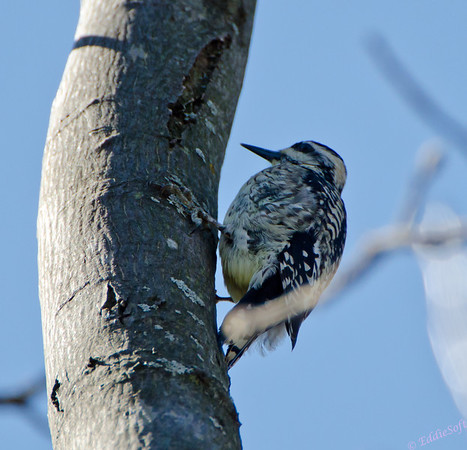
I’m a little off my schedule at the moment due to the little issue I had to take care of in the last post.  With that all past us now (and if you still think Linda isn’t the 2012 UB you need to go back and read the finely tuned analysis on the previous post), I can try to get through another entry in the Wisconsin Birds series.  This one is actually a bit of a mystery and hoping one of my fine readers can help me out a bit.  We were up on the cliff trail above Devil’s Lake when I heard a very familiar drumming a little ways into the woods (opposite cliff side).  I’ve been diligently searching for a Pileated Woodpecker without much luck so every time I hear that rattle I jump into search mode and start tracking.  Anyone watching me would have been trying to hold back a laugh.  Finding woodpeckers can be difficult in a dense forest – I swear their drumming echoes off of every try in the area.  Usually I walk to what appears to be the center point of the echoes and move my head in various directions looking for the the sharpest rattle position.. then walk a ways in that direction and repeat.  It looks stupid to onlookers, but it is effective.  After about 3 cycles of this I came upon this:

My initial guess through the viewfinder was a Downy Woodpecker.  Some doubt crept in as I was taking additional shots.  The most interesting aspect was the bird had a yellowish tint to it – most noticeable behind the head and on the breast below the legs.  Depending on how the light hit it, there seemed to be some yellow tint in the white areas on the back and wings.  We have numerous Downy’s where we live and I’ve have had a lot of opportunities to photograph them.  To my recollection, all of those Downy’s had very white highlighting and breast markings.  I tried changing positions to get a better shot of the head but that was difficult to do and still avoid all the branches.  The shot below was the best result, but a foreground branch managed to sneak in.  This shot, however, brought up an additional concern.  That beak is larger than most of the Downy’s around here which are smaller in relationship to the face.  They also look sharper than the one sported by this specimen.

Hit the jump to read more about this mystery bird.

Continue reading A Devil Pecker… But Not Sure Which?

The Good and the Ugly – A Wisconsin Twofor

Been a little hesitant to make another post after the blistering I took for the less that tack sharp images from the previous post.  This was mainly due to a few of the following shots being a little bit off as well.. hey, let’s go with the “style” excuse.  Actually, there is a reason for the ones below that are less than crispy.  All of these are flight shots taken while hand holding The Beast.  I’ve been working out but it’s going to take some extra reps and protein before I’ll feel comfortable chasing birds across the sky with an 8 pound glass.  I also have not committed to limiting the travel of the glass so once it focuses off the bird it is burden to get it back on target.  This isn’t so much an excuse as it is a celebration of success when one hits the tin in decent condition.  All in all, the following set isn’t that bad .. not gallery potential.. but still worth posting.

Today’s set features not one, but TWO birds and not those tiny Finch types.  When these fly over your head you take notice and every critter under 3 pounds has a near heart attack.  Although, if it isn’t already dead or prefer the water, these two birds are probably going to leave it alone.  One is a majestic bird of grace and color (the good) and one makes you wonder if they were designed by Wes Craven (the ugly).  Both were taken at Devil’s lake near Baraboo, Wisconsin.

First out of the gate is the Blue Heron.  This is not an unfamiliar bird to the blog (see here) and that is because it is one of my favorite shooting targets.  They are interesting to look at and have the photo friendly trait of remaining motionless for long periods of times – perfect for longer exposures when you want to push the ISO down as much as possible.  When we arrived at Devil’s Lake, we really didn’t see a lot of birds in the water (correction.. didn’t see ANY birds in the water) which was not the way I wanted to start the Wisconsin vacation.  The large rocks around the lake made a really nice setting.  So much that Linda decided she wanted to take a few shots of her for the business site.  With the longer glass I was standing back a ways to take the shots when all of a sudden a Heron landed on a rock about 20 feet from where Linda was sitting.   I couldn’t believe what I was witnessing – we were just about the only ones in the area with plenty of more solitaire places all around the lake.  The camera settings were manually configured for portrait mode which didn’t lend itself to bird shots.  By the time I got everything adjusted, the Heron took flight again.

The battle was on to keep the glass on the bird while it gathered air under its long wings.  There is one thing more enjoyable to watch than a Heron on the ground stalking dinner and that is a Heron taking flight.  Those long wings fold out, the neck curves back and those feet come together to complete the aerodynamics.  From afar, those legs are often mistaken for long tail feathers.  Every time I see one of these creatures sailing through the air I immediately think of my early school years when they taught us about the Pterodactylus .. my favorite member of the Jurassic Period (and probably the early seeding of my desire to become an archeologist) – editors note: I am still bitter of being taught the lie of the Brontosaurus .. I also want my planet Pluto back but I’ll save that rant for another time.

Here is another shot of the bird.  I was doing my best to pan along the flight path trying to keep the single focus point on the bird’s eye – thank god for Rear Focus allowing me to keep the focus where I wanted it.  The raised tips at the extent of both wings give a nice composition.  Not sure if I like the sand coming into the frame yet, but I was at the mercy of the bird’s flightpath.

Hit the jump to read more about the Heron and the bonus bird.

Continue reading The Good and the Ugly – A Wisconsin Twofor

The Ducks that Got Away – Drats

Greetings once again all. I gave you a slight reprieve from the Wisconsin Birds Series at the end of the last month, but there are a few more to get through before closing out this series and moving on to Wisconsin Birds Series II (yep, thanks to taking so long to get through the first series, we’ve been back to the Land of Cheese and now have even more shots to share). Unfortunately, this particular post is bittersweet. On one hand it does provide support for a new checkmark in the bird list, however (head hung low, eyes wandering) it is also an unfortunate highlight of the execution fail.  Having exhausted the ponds and lakes around Baraboo, we headed up further North about 45 minutes to a County Park.  Neither of us can remember the name of that park but I do remember parking near a large observation deck positioned in the a middle of a field surrounded by a forest .  The trees here were experiencing distress from some form of bug, blight or maybe a fire – tough to tell other than an earlier walk down another supposed observation deck uncovered large construction vehicles in the midst of bulldozing some of the larger trees down.

Signs indicated a trail to a pond so we grabbed the gear and headed out.  After about 15 minutes we came upon a lonely pond and immediately thought PERFECT! Nobody around, secluded, and a clear view to the pond… and there was water fowl taking a leisurely paddle. I set the tripod down and went for the customary far shots so I would have something to show for the effort.

and…. we have come upon the very rare fuzzy duck!   Okay, okay, so it was a poorly executed shot. I am not sure exactly what happened other than likely a bad compensation for the now very overcast afternoon (the downside of now shooting only in Manual Mode) or weakness in trying to hand stabilize The Beast. In either case it was my bad and I take full responsibility for it. On further thought, it might have just been excitement knowing this bird hadn’t made it into my tin as of yet. Even with the fuzziness, you can still tell it is a Ringed-Neck Duck – both a male and his mate.  Here is another shot of just the male (no, the images do not get any better) that confirms it.

Hit the jump to read more about this new duck to LifeIntrigued.

Continue reading The Ducks that Got Away – Drats

A New Warbler Addition

Since you patiently read through the last somewhat boring bird (the Mallard) post, I figured it would be prudent to now offer the latest new bird to my collection (the one I promised at the start of the Wisconsin Birds series).  With that…. drum roll … I’d like to introduce what I believe to be the Yellow-Rumped Warbler.

This male Warbler was shot at Devil’s Lake near Baraboo Wisconsin.  As with the rest of this series it was taken over last Easter Weekend.  We were actually up on the very picturesque cliffs overlooking the glacier formed lake when this bird flew over my head and landed in a nearby tree.  At the time I trying my best to capture Turkey Vultures which were circling the cliffs.  The frustration levels were mounting trying to get The Beast zeroed in and focused on those birds which, due to the height of the cliffs, were actually speeding by below us.  The yellow markings on this Warbler were pretty unique which caught my attention immediately.  Screw the Vultures, we’ve got a new bird to track down.  One thing that became painfully clear with this Warbler (and likely generalized to all of these Warblers) is it did not want to stay in one place very long at all.  It would land, give me about 3 seconds to get the big glass in position, get the exposure settings right and finally take one shot.

Hit the jump to see more pictures of this new Warbler

Continue reading A New Warbler Addition

Mallard Slumber

It occurred to me that as of late, I’ve been doing a bashing of the Mallard and thought it was time to ease up a bit.  If you recall there has been some assumptions regarding just how promiscuous this bird is – for reference, check out the muta.. I mean interesting specimens here and here.  The little known but powerful Mallard Urban Transgressions and Neglect Tracking Society has contacted me with a cease and desist.  Trust me, you do not want to stay on their bad side.  As an act of restitution, today’s featured bird is the Mallard.  Unless you live under a rock or in The City (sorry, inside college joke) you have seen one of these at your local river, lake, pond or for that matter the roadside ditch.  They are indeed the most abundant duck in North America and the male markings make it very easy to spot – note, this is not true of the female mallard which is about as common looking as you can get with the exception of the blue teal patch on their wings.  On our way back home from Wisconsin, we stopped in downtown Dells to see what was playing in the river that runs through the middle of it.  After walking a ways down the nice path they have for pedestrians I noticed this Mallard catching some Z’s under a bridge.  It must be nice to be able to carry your pillow with you wherever you go.

Due to the bridge supports and an outcropping of brush and trees, there was a limited viewing angle (I’m sure that was his intention when selecting this spot).  For about 20 minutes I wrestled with foot compositioning in a futile attempt to clear the shot of branches but still capture all the rock pedestal.  At one point in this effort, I banged the bridge beam with my knee and my yelp woke it up.  He gave a quick look around before eventually settling back into his slumber.

Eventually some of the rock had to be sacrificed to get most of the other distractions out (looks like my cropping effort on the right side was just a wee bit short but guessing it would matte out in a print anyway.  After all that work none of the shots would make my gallery list, but I’m finally starting to concentrate more on the in camera composition which results in an easier time in post processing.

I will say the subject in the above picture isn’t that exciting, but I really like the texture that came out in the water.  It kind of looks like molten glass.

Hit the jump to see some additional shots of the Mallard along with a composition discussion.

Continue reading Mallard Slumber

A Majestic Domestic Spotted in Baraboo

Once again, we are back in Baraboo, Wisconsin but this time with specimens from the Goose family.  First off, an apology.  The title of this post really doesn’t fit based on a crap load of Internet research.  After frying a bunch of synapse coming up with a clever title I hated to give it up so we are going with it.  This series of pictures was taken on our way home from our Easter stay at Chula Vista Resort.  just outside the Dells.  Our trek home took us through the city of Baraboo which always makes me shudder in fright  … who in their right mind would take the effort to make a Circus Museum?!?  I’ll answer that, a DERANGED CLOWN LOVER that’s who.  Give me a second to get the heart calmed down..

beatbeatbeatbe atbe atb e atb e atb e a tbe e a t b e a t b e a t   ahhhh that was close

Continuing on, there is a nice stream that runs through that city which can be seen from the main thoroughfare (as it heads to Devil’s Head if you are curious).  On that day we spotted a couple of birds hanging out along the shore.  Not wanting to pass up a shot opportunity I had Linda turn onto a side road for some in vehicle shots – the Beast was on the camera so there was plenty of reach.  Turns out we were stopped right next to a No Parking sign and some cars were giving us disproving looks.  Not wanting to ruffle the locals, Linda dropped me off and started cruising around while I took some more shots from the banks.  Turns out the final product had a nice surprise.

It was high day which put up a pretty good fight on the exposure effort.  Admittedly, there is some blowout just below the neck, but was able to recover a lot of the feature detail outside that (embrace the RAW).  At the time, the small LCD screen was not able to really show a unique feature of the bird, but once in the digital darkroom it came out crystal clear.  Let’s move in a bit so you can see for yourself.

That eye is just plain gorgeous.  The orange eyelids really make it pop against the white coloring.  The sun angle even gave the highly desired glint.  To do it again I would have backed the exposure off one or two stops and then brought the light back in post processing.  Recovery restored a lot of the detail around the head, so a tighter crop would take out some of the blow outs, but there needs to be some of it left – otherwise it would look like someone took an ax to it (eesh).  As an example, here is another tight crop which gives even a better view of the eye but again, a less appealing crop from an overall composition perspective… and yes, I needed to apply some additional recovery on this version to get the detail back in the head feathering.

Hit the jump to see more pictures from this post

Continue reading A Majestic Domestic Spotted in Baraboo

The X-Ducks of Wisconsin

Howdy all, I was recently reminded that we are half way through the steamy month of July and there is yet to be a post on the blog. You would think with how hot it has been in the last two weeks I’d be cranking out post after post in the comfort of my air conditioned den. On the contrary, I’ve been swamped with activities as of late which has included wrapping up phase one of my summer project (literally put the last piece in that phase a mere two hours ago) and a healthy (or not) dose of heat running conditioning needed for the Bix race at the end of the month. I do not want a repeat of the Steamboat race and it looks like there has been some improvement based on my recent Bix@6 training run (93-95 out when the training race started last Thursday and it went quite well). The good news is all the post processing work on this month’s series of posts is already complete!   …and just what is the topic this month…

After much thought and contemplation I’m going with the birds captured during our photo shoot taken  in Wisconsin over Easter. Tragically, this means another month (at least) will pass before getting to the Indy Zoo pictures and the birds of Banner Marsh.

It’s quiz time.  Any guesses as to what that water fowl is (note, these are all non-shopped)?

If you can identify it, please feel free to let me know.  As far as I can tell this is another mutant specimen.  If you recall, this is not the first mutant to grace these pages.  The mallard derivative from the Emoquon series certainly fits this category (link here).    This strange bird has more of the duck features than the goose characteristics in that previous one.  It was also easier to pick out the main ingredients that made that bird.

This on the other hand doesn’t really match anything.  The dominant white and the the black tail feathers would put it somewhere in the Snow Goose realm (or just the white neck and orange beak has traits of an Embden Goose), but it took the stature of a smaller duck.

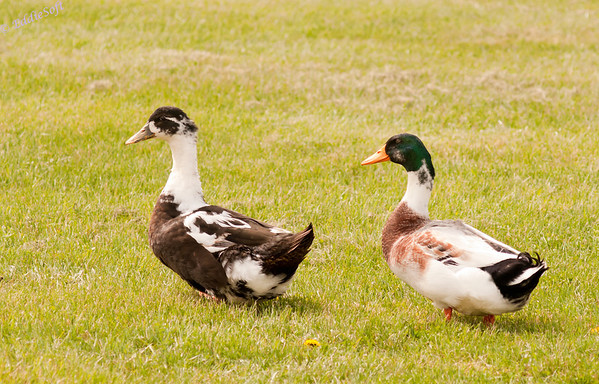
it that wasn’t fun enough, let’s move on to mutant specimen number 2 and 3.  The one on the right looks like someone sawed the head off the one above and slapped a better Mallard head on it.  Those Mallards must really like to sow their oats.

Shifting to the one of the left.  They were hanging together so the assumption is they were mates.  The left is likely the female due to the dominant male Mallard coloring on the right one.  It looks closer to an Eskimo Sandwich than it does a duck.  The breast feathering almost has a turkey composition and nothing in the reference books really showed markings that chocolaty.

Hit the jump to see even more strange waterfowl.

Continue reading The X-Ducks of Wisconsin