A Day in the Land of Odd

Happy Holidays everyone!  With all the activities as of late it has been difficult to find time to get out the remaining posts of the year. .. and by activities that includes tonight’s accomplishment of finally drumming through every single song on my Xbox for Rock Band 3 on pro-drums – including all three cores (RB1/2/3)  expansion packs (LEGO, AC/DC) and too many downloaded songs to admit in public.  Since I had a few minutes to spare while resting the arms, I thought I’d crank one out that I did the prep work on just a few days ago.  While going through my list of ideas I noticed one that has been on there for a looooong time.  To be specific, that would be like 1 year and 7 months.  This is actually a mixture of shots taken by both myself and Linda although not entirely sure which is which so for the most part assume equal credit.

So, back in May of 2011, Linda and I had the opportunity to visit an old friend of mine called Allerton Park and Retreat Center near Monticello IL (link here).  If you were fortunate to attend the University of Illinois, it is likely you are familiar with this location as it is a nice place to get out and away from the grind.  My brother Ron first introduced me to this place while he was going to school there.  The best thing about this place is that it’s more than just a place for some peace and quite – it is also a rich environment for creativity and a godsend if you are in to “photographing the odd”.  The site was the estate of one Robert Allerton who was heir to his father Samuel’s fortunes from his association with the First National Bank of Chicago and many stockyards including the Union Stockyards of Chicago.  Robert was passionate about art becoming an avid collector and philanthropist.  This passion resulted in his estate becoming  full of eccentric sculptures collected during his worldly travels.  Robert was also heavily involved with the University of Illinois along with his adopted son John Gregg.  I was not aware of this before reading up on Wikipedia and their official site, but it was actually deeded to the university back in 1946 (one of the largest gifts to date to the university).  I’ll let you read up on the history of this place, but hands down, if you are looking to spend the day behind the camera .. this is an excellent place to start.

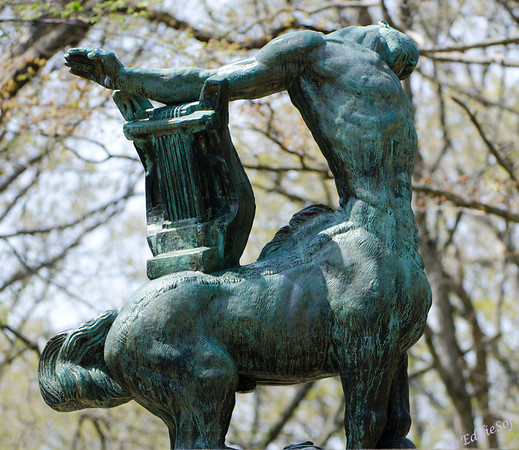
First of all, there are statues all over the property that are stunning in both their size and subject.  Take for example this one.

I believe it is called Death of the Last Centaur.  Guess this is a good time to mention that a large majority of these images were SHOPPED.  I admit it (unlike Peter Lik) but the digital darkroom is one of my favorite parts of photography.  Unlike with wildlife photography I take a little more liberty in landscape shots – the animal world is a little more picky on maintaining the “natural” coloring of the species.  I wanted to learn some advanced techniques and the shots from Allerton provided a fertile ground for that.  I’m guessing from the wide angle shot that Linda actually took the one above – otherwise I would have had to hiked about 1/4 mile away to get that coverage with Beast.   The shot below shows the tighter ones I was shooting.  My goal was to fade out the background so the statue would pop a little more.  A lot of work with masks and filter brushes in Lightroom got me here.

Not bad, the sharpness of the status stands out better than in the first shot.  Some color manipulation accelerated the timing about 5 months into the fall.  The next task was to try my hand at some B&W and tone manipulation.  This is harder than initially thought.

The background did not lighten up as much as desired – need to read up a little more on the Dodging and Burning in the tool but the statue’s coloring came out close to expectations – it would have popped a lot more on a lighter background.  Maybe next time I’ll see if there is an angle that takes some of the trees out.

Hit the jump to see other shots from Allerton…

Continue reading A Day in the Land of Odd

One of These and One of Those

Greetings all!  Since I’ll probably not be posting again until after Thanksgiving, I’d like to wish everyone a happy Turkey Day (well, guess not so much from the turkey’s perspective) and safe travels if you are out and about.  Today’s post is a two-for of sorts.  Not only do you get to see a … umm a “this” but you also get to see … uh well umm a “that”.  As you can tell, I’m not entirely sure what they are.  There are a few guesses but, in truth, hoping my highly knowledgeable and gracious readers (the butter-up) can help out.   Begging is an option if needed – my pride is already dashed from flipping through bird books and slogging through the web for a staggering amount of time.

The first bird comes to us from Banner Marsh back in September.  We were heading down to Emiquon to catch the pelicans that were migrating through.  We had some time to spare so hit the Marsh first.  As soon as we pulled in I noticed something wading far out in the water.

It kind of looked from the shape like a stilt (link here) but it was clearly at the max reach of the Beast even with the Tele. Hand holding that glass on such a distant subject is difficult at best and not conducive to crispy shots.  My apologies, but these are the best that could be done with them in the digital darkroom – I did not want to mess up any coloring on the bird since it hasn’t been really identified yet – also had to do some major cropping just to make out the bird.

Hit the jump to start the guessing on this bird and to view the second subject of this post

Continue reading One of These and One of Those

The Thrill of Shooting Babies

RELAX! RELAX!… that’s just a clever hook to get you to walk in the door.  Although I’m comfortable behind a handgun or rifle, I was referring to my other hobby – “shooting” wildlife with my CAMERA.  Clearly the big game and birds dominate our photo outings, but every once in awhile we are lucky enough to have the smaller subjects drop by the house for some quick posing.  This is exactly what happened back in June.  I was piddling around (Linda’s words) when I stumbled upon one seriously pissed off raccoon.  Now I am not a big fan of adult raccoons firmly believing that they are one evolution away from throwing us off the top of the food chain.  They clearly spend their free time thinking of clever ways to wreak havoc on our house – especially the bird feeders (and not wasting it on Internet searches for Hank Williams Jr.)  .  Fortunately for them, I have a golden rule – The Young Shall Not Be Harmed Nor Adults In Company Of Their Young.  I know the consequences when they become adults, but everyone should have a right to enjoy the innocent years.  The 8 baby mice that I came across in our propane tank lid resulting in having to spent 45 minutes rounding up and coaxing their mom to lead each to safety last month can attest to this (probably should be some commas in that beast of a sentence).  I know that some will make it to adulthood to drive me nuts but convictions are convictions.

I’ve had enough encounters with raccoon mothers to know when babies are close.  Like this one they turn nasty and start hissing and baring their teeth.  Due to being an evolution away, they eventually recognize their shortcomings and try to draw the danger away.   If you simply stand your ground they eventually give up and head for safety.  Don’t be fooled, they do not go very far but create enough distance from you that you tend to forget they are out there.  Whenever this happens I start looking to the trees to see what was worth trying to protect.  One thing their mother’s always teach their offspring – when in trouble take the high ground.  This eliminates a large number of threats around here and cats pretty much want no part of this game.  Sure enough, not far from where I was standing was this:

How cute is that!  As much damage their parents have done around here I’m going to get a little benefit.  Linda happened to come out of the house at the same time so I had her grab the camera.  Raccoon babies are excellent photographic subjects.  They tend to stay stationary and have a cute factor that is through the roof.  The struggle with this one was getting the composition right – no matter which angle I took there were leaves in the way (not too surprising since we do live in the woods).  The wind was also blowing adding another factor to the mix.  A few minutes into the shot we were greeted with another surprise.

Score – double cuteness.  They were fairly calm about the whole ordeal likely due to the fact I’d come upon them before and let them pass without harm – no camera then though.  Our attention kept them very alert.  Their ears were nicely tuned forward and for the most part they kept those eyes wide open (very glint friendly).  See that paw clinched onto the tree?  Should this particular baby make it to adulthood, that paw will be continually testing all my bird feeder protections.  Note, when looking some information up on these critters I was shocked to learn that they do NOT have an opposable thumb yet since I was a kid always thought they did – another childhood education fallacy in the vein of the Brontosaurus and Pluto – they may actually be more than one evolution away now.

There’s more (literally) .. hit the jump!

Continue reading The Thrill of Shooting Babies

The Good and the Bad of Big Glass Depth of Field

Greetings all! I am finally getting back on my feet after the month from hell. Once all the adrenaline and excitement wore off from the race and party I started realizing what a toll it all took on my body. Even with my customary week off relaxing (yep, no running, and no work on Project Auuunoold) I still couldn’t shake the aches and pains. The next week started and I was beginning to get concerned. Figured I’d start the rebuilding process this week … back on the core to get the body fixed up and stretched and a little biking for cardio is starting to work their magic. Still not ready to run yet but due time, due time. In the meantime, thought I’d toss out a quick post.

Tonight’s topic is that very tricky subject of Depth of Field (DoF). To be honest, this is one of those photography topics I am trying to get a better understanding of – primarily because I’m constantly fighting it out in the field especially with the Beast. My quick and dirty definition of DoF is the measurement of how much distance will be in focus (sharp) for a given set of exposure, glass and camera specs. I still have a lot of learning to do on this subject so there will not be any expert advice here – I’ll certainly come back on this subject once I get read up on it some more. The good, or the bad depending on your point of view, is that you can see the effect pretty easily.

Take a look at some shots from a shoot Linda and I took back in July. We were out at Jubilee and due to lack of birds was spending my time on anything else I could find that had wings.

So there I was with my standard birding setup which consists of the Beast (200-400mm) coupled with the 1.4 Tele on the D7000 (1.5 crop sensor).  These shots were taken at around the 3.6 to 3.8 m range hand held… and people wonder why I continually workout.  These dragonflies were all over the place darting to and fro so I decided to get a little small subject focusing practice in.  When the subject is smaller than the central focus region, the glass tends to walk a lot, especially the long glass.  So there I stood happily shooting away.  That happiness lasted until I got home and started assessing the output.  Notice anything glaring wrong with the first shot?

The right wings are nice and crispy, but what the hell is up with the left side?  Was that particular wing moving at the time … doubtful, they tend to move both sets of wings in unison from what I have experienced and the 16oo ISO would have compensated for that anyway.  The problem is in the focus parameters.   My depth of field is not encompassing the full thickness of the subject.

I was fighting the glass to keep it on target and firing away on fast multi-shot so there were plenty of other examples to explore.  Hit the jump to see more examples of DoF.

Continue reading The Good and the Bad of Big Glass Depth of Field

Making the Best of a Dreary Day

I have entered the lair of the enemy and lived to tell about it. How is that for a dramatic intro? So truth be told, for the last three days I have been in Iowa. Specifically, I have been in Iowa City, the home of black and gold and a dreaded enemy of Chief Illiniwek. Why would I subject myself to three days of Herky Hell? What would bring an Orange and Blue die hard to subject himself to an arch rival? Actually, the answer is pretty simple. Linda had the opportunity to benefit from their fine medical facilities at the University of Iowa and for that I will gladly swallow my pride and express my gratitude. I think we are now on a good path to getting some issues under control and if it takes a little humility to make that happen – well, bring it on. Just for the record, I’ll still root against them in any sports competition… although since the Illini once again suck pond water it will be done with more of an inside voice.

One impact of this is a significant reduction in available blogging time. With Project Auuuunold in full bore, another half at the end of the month and taking care of the other issues it doesn’t leave much time to tickle the keyboard. It is too early to throw in the towel, but need to warn you the focus will probably be on photography related topics since the post processing work is actually faster than the prep work for the other types of posts. As a start, here is a set taken off my porch one dreary day a few months back. There is a lot still to learn about the Beast and a little low light practice is never wasted. The Beast is a VRII 4.0f end to end glass . With the 1.4 Teleconverter on, it drops to 5.6f which thirsts for light out in the field. It was time to try out some different settings and modes to see how best to shoot birds when the light is not ideal. One bi-product of the drizzle caught me by surprise.  See anything interesting in this shot?

Nothing catch your eye?  Hmmm, how about another shot in a more traditional crop… hint, you might not associate this as a typical BoaS?

Hit the jump and I’ll zoom you into the subject.

Continue reading Making the Best of a Dreary Day

The Exotic! Youuuuu Caaaaan’t Haaaaandle The Exotic

I’ve been thinking about Linda’s comment regarding my recent post of a Hawk (link here) and her reference to it being too boring for my blog.  She’s claiming that she is just looking out for the best interest of my peeps.  Well, this has been the main noodle topic on my training runs as of late.  What can I do to address this perspective and maybe even provide that needed push I need to get caught up on our photo shoots.  It occurred to me at mile 10 last Wednesday that I have the perfect remedy.  I do indeed have shots of more “exotic” birds and those are actually on my to-do list from back in July 2011.  And people still wonder why I subject myself to the torture of running…. well other than letting me eat what I want (hehehe) it gives me ample time to noodle and I’m betting everyone could use a little more time to noodle.

If you recall, I previously posted a few pics of the Indiana Zoo taken by Linda (link here).  To complement that I will now roll out the carpet for the first of the Indianapolis Zoo Aviary shots.  Drum roll please.

Is that EXOTIC enough for you?  Guessing you might have just gagged a little bit.  Hey, they all can’t be studly like the Hawk!  This is obviously not a bird you will come across just walking in the park here in the US.  To be honest, I couldn’t even locate this bird in any of my bird references (I do have a few that cover more than North America like the Sibley guide).  This required me to hunt down the Indianapolis Zoo website and go through their animal list until I located the birds (yes, there is more than one in this set).  Without a guide reference I had to once again employ our friends over at Wikipedia.  Turns out they have a page devoted to both the birds on this post.  This creature which only a mother could love comes from Central Africa.

In clear evidence of evolution, this bird was obviously maligned by the pretty boy birds to point where distance became his only friend.  This led to becoming one of the highest flying birds with the ability to exceed an elevation of 36,000 feet.  Jonathan Seagull has nothing on these creatures.  The impressive flight ability is definitely aided by their 7 to 8 foot wingspan, but still impressive for a bird that can upwards of 20 pounds.   Clearly they follow the vulture trait of living off of carrion, but I am sad to report that this bird is listed as endangered.  Note it lost two notches since 2007.  Let’s all give our best wishes that we can save this bird for our future generations to gag.. I mean observe.

Okay… Time for the second bird.  Please put down any food you might be eating at the moment and consider moving your keyboard away slightly to the left or right to cut down on cleanup.  Take a deep breath and hit the jump to see the second bird in this post.

Continue reading The Exotic! Youuuuu Caaaaan’t Haaaaandle The Exotic

A Pleasant Feathered Surprise

If I was a pressure cooker I’d be whistling up a storm about now.  More like a “perfect” storm from trying to prepare for a practice run to help friend learn the course for our upcoming relay marathon, working on Project Auuunold, trying to resolve some difficult architecture issues at work and most stressful of all, being two posts short on the last week of the month.  I’ve come too far this year to blow my quota so I will officially give up sleep and try and get through it.  The good news is this post topic literally fell out of the sky into my lap.  Umm, that might be a slight exaggeration, it actually did not land in my lap, rather in a tree about 30 feet from where I was sitting on our porch.  As luck would have it, I was actually out there photographing some of the many hummingbirds that have made our porch feeders their regular stomping grounds.  The ones I was focusing on ended up getting startled by something and split for the woods.  Not a big issue since they find their way back after about 15 minutes of calm.  During this delay I was fiddling with the Beast settings when something darted by and took up perch in a clump of nearby leaves.  Hello there greenish bird I’ve never seen around here before!

A quick flip to my user setting for bird on stick and I was snapping away.  By the way, I need to commend our friends at Nikon for adding the U1 and U2 Manual modes to the D7000.  This has been a godsend for quickly moving between stationary bird settings to bird in flight mode.  A quick flip of the dial brings my ISO to 400 and shutter speed to a slower setting for the perch shots and when it decides to take off all I need to do is flip it again to get my ISO up to 800 and shutter speed doubles – from that base I can quickly adjust the exposure setting to capture the moment.

Since I had not shot this bird before I was concentrating on getting a variety of poses and views to help identify it – head shot, breast shot, wing shot, tail shot etc.  This turned out to be very helpful during the identification phase.  Based on a discussion with John at work and a hefty amount of research both in my reference manuals and Google, I narrowed it down to a Vireo and then specifically either the Warbling Vireo or the Red-Eyed Vireo.  Both of these breeds have compatible ranges so that checked out good.  Both have a greenish hue and display a white to blush yellow  breast.  Initial indicators made me lean to the Warbling type.  There were some reservations regarding the fact the Warbling has as smaller stature than what I witnessed and the beak looked smaller on them than on this specimen.  The National Geographic North American Bird guide threw me with their illustration of the Red-Eyed Vireo – their graphic indicated a much darker green to grey wing coloring which did not match this bird.

Hit the jump to read more about this new bird to the Blog

Continue reading A Pleasant Feathered Surprise

Something More Exotic – The Green Heron

Now this is embarrassing.  Linda actually gave me grief because I chose to spotlight a “boring” (yes, that is the exact word she used) hawk in my last bird post (link here).  I was quite stunned seeing as how I thought it was a pretty cool bird even if it isn’t so rare in these parts.  It has a deadly beak, razor sharp talons and an extremely efficient killer.  What’s so boring about a Red-Tailed Hawk?  Her response – you need to feature something more “exotic” (again, her exact word).  First of all, we live in Illinois – my options are pretty limited beyond our various wildlife vacations.  Good thing she apparently missed my post with robins and sparrows (link here).

[sorry, emergency break needed – I have to go rip my Illini shirt off and throw it in the garbage (they are now losing 45-17 in the 3rd qtr at home)… be right back….sorry about that .. now back to your regularly scheduled post]

Where was I.. oh, so the pressure was on for this post.  Nothing like being called out by your number one fan.  I was actually planning on holding on to this one a little while, but due to the situation I am forced to bring it out now!  The newest entry in my bird list is …..[drum roll]

….the Green Heron.  This bird literally dropped in on us one day while we were out taking pictures in Jubilee Park.  Actually, we were testing out some glass we rented from rentglass.com.  We are considering upgrading our 200mm workhorse to a newer VR equipped version and wanted to see how it compared to our existing glass.  There wasn’t much going on at the pond in terms of birds so I was off shooting dragonflies and anything else I could find that at least had wings.  Linda was a ways back taking some shots of dirt or something (hoping for something to miraculously fly into the field of view hehehe).  All of a sudden I see a large silhouette fly by on the other side of the pond and take up a position at the very top of some large trees overlooking the pond.  It was not apparent exactly what it was – looked kind of like a Blue Heron, but it looks like someone had squashed it and gave it a much thicker beak.  Immediately I began trying to get Linda’s attention (since she was closer to it) without startling the bird.  This was basically fruitless so made my way back to her.  The bird was really to far for the 200mm so switched the teleconverter over to The Beast and went about trying to get as good a shot as possible which primarily consisted of trying to compensate for the backlight.  In general, the shots are not as crisp as I would have liked, but I’ll give myself a break with the conditions – thankfully there’s the magic of post processing.

Back at home it didn’t take long to identify the Heron – the benefit of NOT looking like a sparrow.  This particular one is likely a juvenile since the coloring is still in the brown range where the adults sport the more green/blue hues on the head and wings.  These birds are generally found in a family group or, as in this case, solitaire.  According to the National Geographic Complete Birds of North America reference, this is one of the few NA birds that employ tools to hunt.  They will place an item like a leaf or piece of bread on the surface of the water to lure fish into coming to the surface and thus right into their trap.  Guessing they are just a few evolutionary years away from developing bow fishing.  One thing I found extremely fascinating – a polite description for really being creeped out by it – was the eye placement.  Looking from the side it looks fairly normal (reference first image).  However, from directly below you can see the eyes actually appear to be sticking out from the side of the head.   This must be handy when fishing since it can watch the kill zone without bending its head down to the water like the Blue Heron.  For my loyal followers I risked thorns and swarms of mosquitoes to move in closer so you can witness this strange arrangement.

Hit the jump to see a few more pictures of this interesting bird

Continue reading Something More Exotic – The Green Heron

Book Recollection: Creative Bird Photography

I am pretty ashamed of myself right now.  Remember that goal of getting through my ever growing stack of reading material?  If not, I completely understand since I haven’t posted a book recollection since ..wait for it .. wait for it.. APRIL (link here).  Pretty pathetic, but there are some reasons for that and most of them result in just being too tired or busy to sink myself into anything with any intellectual depth.  As a result most of my night and travel reading has been running and health magazines that invade my mailbox once a month.  There are usually some interesting quick reads in the running journals but I am quickly coming to the conclusion that my health mags are worthless – give them three months and they will contradict every recommendation they gave you in the current month.  I’ll be ending those and my Guitar World subscription at the next renewal.

The bright spot in all of this is I have been turning a few pages in a real book every once in awhile.  Somewhat shocking I actually came to the index on one last week.  Which means it’s time for a new Book Recollection – WOOT!!  Today’s entry is about an offering from Bill Coster on Creative Bird Photography: Essential Tips and Techniques.  Pretty sure Linda picked it up for me – obviously she knows me pretty well.  This is a 160 large paper bound book printed on nice stock pages which make the numerous pictures stand out nice and crisp.  To be honest, it was more of an inspiration book than a volume of new information.  This isn’t Bill’s fault but I have read so many books and manuals on wildlife photography that it takes something revolutionary to really grab me.  However, if you like perusing some of the best bird photographs you will ever see.. then this book is for you!  This is where the inspiration comes from – nothing like seeing successful shots out in the field to get your juices flowing to go out there and try to get your own gallery shots.  When it comes to bird photography, Arthur Morris is clearly in the cream (can check out his work out here) Beware, that dude is a Shopaholic in case you have some angst on that (I DO NOT).  Based on the images in this book I am going to add Bill into this elite group as well – strange that I have never stumbled on his work before.  He also gets extra props because he started in the IT Industry before going full time into photography – his sweet spot back then were birds in flight which were pretty rare in the film days.  This led to his employment with one of the top natural history agencies in Britain.  Oh, did I mention he was raised in London?  This particular book was based on a series of articles he wrote for Birds Illustrated magazine – maybe I’ll replace my health subscription with a bird journal .. maybe even on the iPad.  He does an excellent job of giving the details (bird type, location and exposure information) for all the shots in the book.  Note he is a Canon user – let’s all let out a collective siiigggghhhh.

One thing that becomes very clear in the book is Bill has a lot of spare time and is very patient in the field.  He details all of the locations around the world he’s been able to shoot at (many of which I’ve added to my travel list) and continually mentions the multi-day outings just waiting for a bird to show up where he wants it to.  This is a huge advantage over holding down a full time job in the IT world.  I actually have a pretty big list of takeaways so clearly it was worth the read if you can call 160 pages in 5 months actually READING.  There are 38 unique birds (class and common name combined) within the covers (yes, I counted them) and I’m sure some of them you have never seen in person.  If you are new to bird photography or wondering why anyone would take up this pastime, then this book is for you.  If you want to judge how far you need to go before you can call yourself a real bird photographer, then this book is for you (answer a LONG ways for me) or if you just like looking at “purdy” pictures then … this book is for you.  If there is one negative on the book is that it just simply ends.  One moment you are learning about Tilt Shift photography, turn the page to see a couple full spread shots of bird flocks and next thing you know you are staring at the index.  No words of encouragement, no go out and win one for the Gipper speech (speaking of which Notre Dame is currently kicking the crap out of Michigan State) or thanks for spending your valuable time with me.  None of that, just the index.  This always gives me the sense that the book was rushed or the author became so bored or burdened with it that he was relieved just to make it to the page quota.  Maybe it is just me, but if ever write a book I’m going to take the time to properly polish up the ending.

Well, that’s it boys and girls.  Hope you enjoyed the discussion and find some value in the Takeaways that can be found after the jump.  Until next time, happy shooting

Continue reading Book Recollection: Creative Bird Photography

A Hawkish Perspective

Stand back, there’s likely going to be a spray of dust as this post comes up – been a few days (okay, weeks) since I’ve put one of these babies out.  To be honest, I’m reaching new levels of busy around here with absolutely no sign of let up until after Halloween.  Last week was another big event which is finally past (yes, post to come) but all my free time at the moment is being directed towards my huge Aaaauuunold Project.  However, this is NO excuse to miss a month quota so on with the show!

Today marks another appearance of bird that is secretly growing in population around here.  Up until the last 3 or so years, it was common to drive miles and miles without seeing this particular bird intently scanning the ditches and fields alongside the highway.  Nowadays you are likely to spot one every 5 miles or so.  I cannot tell if this is an indication that rodent populations are thriving or they’re taking a page from the rabbit play book.  The good news is there are plenty of opportunities to get shots of these birds of prey around here.

In case you live in a cave, this is a Red-Tailed Hawk.  As mentioned, it has actually shown up a few times on this blog with the most memorable post being the snake sighting (link here).  There have been a few other Phoadtography posts that had some shots as well, but none of them allowed me to get this close to the specimen.  This particular set of images came from a sighting about 2 miles from my house.  On my way to work I had noticed this bird hanging out in dead tree watching the cars go by, but my calendar was full and thus had to pass up the opportunity.  On the return home I was giving some extra scans along the treeline to see if another opportunity might be had.  Sure enough, it had taken up a position about a quarter mile closer to my home.  This was too good of an omen to pass up so high tailed it to the house, grabbed the Beast and headed back.  Unfortunately, it was backlit by the sun making it difficult to get the shot I wanted.  5 shots later it spotted the huge glass pointed at it and became very skittish – can you blame it?  It turned away from me and took flight up and across the road.  This put him in much better composition position.  More cautious this time, I moved the truck up into position across from it.  This worked muuuuch better.

Hit the jump to see more shots of the Red-Tailed Hawk

Continue reading A Hawkish Perspective